
Why Auckland Leaders Are Turning to Coaching
Something has shifted. The leaders who used to quietly figure everything out alone — who would have considered coaching an admission of weakness — are now among the most vocal advocates for it. Here's what's changed, and why it matters.
Executive coaching has been around for decades. But in Auckland and across New Zealand, the past few years have seen something different: a meaningful shift in who is seeking coaching, why they're seeking it, and what they expect from it.
This isn't a passing trend. It reflects a deeper change in how New Zealand's most effective leaders think about performance, development, and what it actually takes to lead well in a complex environment.
The old model is no longer working
For a long time, the dominant idea of a successful leader in New Zealand was straightforward: someone who was decisive, self-sufficient, resilient under pressure, and didn't need much help. The tough, capable leader who figured things out alone.
That model made a certain kind of sense in a simpler operating environment. But the world Auckland leaders are navigating in 2026 is markedly different — and it demands something the old model simply doesn't provide.
The New Zealand Institute of Management and Leadership identified that the defining leadership challenge of 2026 wasn't strategy creation — most organisations had strategies. The challenge was communicating strategy in a way that resonated with people, and building the authentic relationships needed to translate vision into action. These are deeply human skills. They can't be read from a textbook or acquired through a management course.
They can, however, be developed through coaching.
The authenticity gap in New Zealand leadership
Research from the University of Auckland Business School has identified what Dr Lester Levy, Adjunct Professor of Leadership, calls a significant authenticity gap in New Zealand leadership — where the level of authentic leadership being experienced by the NZ workforce is materially lower than it should be. His research found this gap has real consequences: for productivity, for engagement, and for New Zealand's long-term competitiveness.
“What this research reveals is a challenging picture with significant implications for New Zealand's future productivity and competitiveness.”
Dr Lester Levy, Adjunct Professor of Leadership, University of Auckland Business School
Authentic leadership — leading in a way that is genuinely aligned with your values, self-aware, and transparent — is precisely what the best coaching is designed to develop. And the demand for it, both from leaders themselves and from the teams they lead, has never been higher.
What has changed in the post-COVID landscape
The pandemic accelerated several shifts that were already underway in how leaders think about their roles — and about themselves.
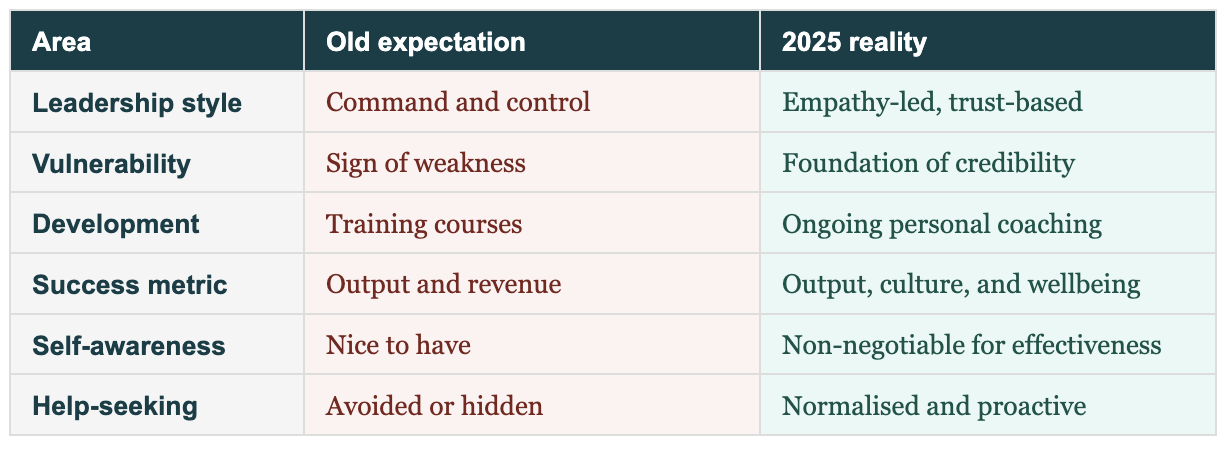
These shifts aren't cosmetic. They reflect what employees, boards, and the market now expect from people in leadership positions — and what leaders themselves are increasingly demanding of their own practice.
Four reasons Auckland leaders are choosing coaching now
1. The complexity of leading in Auckland's economy
Auckland accounts for nearly 40 percent of New Zealand's entire economy. The leaders operating here — across financial services, technology, construction, professional services, retail, and hospitality — are navigating a level of complexity and accountability that has grown considerably in recent years.
Post-COVID trading conditions, persistent cost pressures, AI disruption, and a tighter talent market have created an environment where leadership quality is a genuine competitive differentiator. Coaching has become one of the most direct investments a leader can make in their own capacity to perform under that pressure.
2. The rise of purpose-driven leadership
Across New Zealand's leadership community, there is a growing recognition that sustainable high performance requires more than technical skill or strategic intelligence. It requires clarity of purpose — a genuine understanding of why you lead, what you're building, and what kind of leader you want to be.
PwC New Zealand's leadership development work, the NZ Learning and Development Leadership Summit, and institutions like Leadership New Zealand all share a common thread: the most effective leaders in 2026 are those who lead from a defined, authentic sense of purpose. Coaching is the most direct pathway to that kind of clarity.
3. The demand for emotional intelligence
The skills that define leadership effectiveness in 2026 — empathy, self-regulation, active listening, psychological safety, the ability to have difficult conversations well — are all emotional intelligence competencies. And emotional intelligence, unlike technical expertise, is best developed through structured reflection and personalised feedback over time.
The Great Place to Work New Zealand research confirms that leaders who genuinely invest in wellbeing and trust as leadership priorities outperform those who don't — in engagement, retention, and results. Coaching is how leaders develop those capacities intentionally, rather than hoping they emerge through experience alone.
4. Coaching has been normalised at the highest levels
Ten years ago, executive coaching was something organisations quietly arranged for struggling leaders. Today, it's what the most capable leaders proactively seek for themselves. That shift in perception has filtered through the Auckland leadership community — and it's changed the conversation entirely.
When the leaders people most respect are open about having a coach, the stigma disappears. What remains is simply the question of whether you're serious enough about your own development to do something about it.
What good coaching looks like for Auckland leaders
Not all coaching is equal — and the growth in demand has inevitably brought an increase in coaches whose approach is more motivational than developmental. The distinction matters.
Effective executive and leadership coaching in the Auckland context involves:
A structured methodology grounded in self-awareness and behavioural change — not just goal-setting and accountability
Deep understanding of the NZ leadership culture: the flat hierarchies, the small networks, the particular pressures of leading in a tight-knit business community
A coach with genuine leadership or business experience — so that the thinking partnership is credible, not just clinical
Work that goes beyond performance to purpose — because leaders who don't know what they're really working toward will keep arriving at destinations that don't satisfy them
Where AURA Coaching fits
AURA Coaching was built for this moment in New Zealand leadership.
Our work is grounded in the AURA framework — Authenticity, Understanding, Resilience, and Aspiration — four principles that reflect exactly what the research and the market are pointing toward as the defining qualities of effective leadership in 2026 and beyond.
Through AURA Executive, we work with senior leaders and CEOs who are ready to lead with greater clarity, credibility, and purpose. Through AURA In Balance, we work with business owners navigating the tension between growth and sustainability. And through AURA Life, we work with professionals at a crossroads who are ready to build a life that's more genuinely their own.
The leaders who engage with us aren't struggling. They're serious. They've decided that getting better at what they do — and more intentional about who they're becoming — is worth investing in.
Ready to find out what's possible?
The shift happening in Auckland's leadership community isn't complicated. It's a decision: to take your own development as seriously as you take your business.
Start with a free 30-minute clarity session at auracoaching.co.nz. No pressure — just a focused conversation about where you are and what you're working toward.
Book your free 30-minute clarity session. No pressure. No pitch. Just clarity.
Mark Collins is a transformational life and executive coach based in Auckland, New Zealand, and the founder of AURA Coaching. He works with leaders, entrepreneurs and professionals who are ready to lead with purpose and create meaningful change in their lives and careers.